From Compound Design to BMW Validation: The Engineering Path to OE Approval
Any tire can carry a car from A to B. That isn’t, however, how car manufacturers achieve the best performance from their vehicles. They need tires that support how the car brakes, steers, accelerates, handles road noise, manages rolling resistance, and feels under real driving conditions.
That’s where Original Equipment (OE) approval becomes more than a fitment decision. Original Equipment, or OE, refers to tires developed or approved for a specific production vehicle. OE approval means the tire has passed the manufacturer’s own engineering, testing, and validation requirements before it becomes part of the vehicle specification.
Once those requirements are set, every design choice has to support the same performance targets. Compound choices, tread design, casing structure, lab testing, and road validation all shape how the tire behaves on the road. Environmental expectations also belong in that process, because manufacturers increasingly look for products that support both performance and sustainability requirements.
That technical discipline also helps retailers and end customers understand value. A tire backed by manufacturer-specific validation gives distributors stronger proof than price, label ratings, or product claims alone. OE approval affects performance consistency, supplier confidence, production planning, retailer messaging, and the customer experience after the car reaches the road.
OE Approval Starts With Vehicle-Specific Performance Targets
Car manufacturers don’t approve tires because they fit the wheel size. They approve tires because they support how a specific model has to drive, brake, steer, and feel. The same tire size can serve different cars, but that doesn’t mean it delivers the same result on each one.
That’s why OE development starts with clear performance targets. Engineers and supplier teams define what the tire must do before compound work, tread design, or prototype testing begins. Those targets usually cover:
- Wet braking
- Dry handling
- Fuel efficiency
- Road noise
- Ride comfort
- Durability
- Load capacity
- High-speed stability
Premium European OEMs use internal approval procedures that go beyond standard tire label requirements. BMW, for example, states that its approved tires are tested against up to 50 quality criteria. That level of review explains why OE approval can’t be reduced to legal compliance, size matching, or catalog specifications.
For manufacturers, this early target-setting stage protects the whole development process. It gives the tire maker a clear technical brief before materials, structure, and testing begin. That alignment keeps the project focused on the car’s actual requirements, not on retrofitting an existing tire into a role it wasn’t built to fill.
Compound Design Converts Targets Into Measurable Road Behavior
Performance targets become real only when the tire’s materials support them. Compound design affects how the tire grips, flexes, heats, wears, and resists deformation. That makes it one of the first major engineering decisions in any OE development process.
A manufacturer rarely wants one performance result at any cost. More grip,better fuel efficiency, longer wear, and better comfort all pull the compound in different directions. The work is to find the right balance for the car, not to chase one isolated number.
| Performance target | Compound / structure focus | Possible trade-off |
|---|---|---|
| Wet braking | Softer compound, higher silica content, stronger water evacuation | Higher wear or increased rolling resistance |
| Fuel Efficiency | Lower rolling resistance, reduced heat build-up, and controlled deformation | Reduced grip if the compound becomes too efficiency-focused |
| Durability | Stable compound, reinforced casing, controlled tread wear | Less comfort or slower steering response |
| Ride comfort | More flexible structure and smoother contact patch behavior | Lower handling precision under higher loads |
| Handling response | Stronger shoulders, stable tread blocks, firmer casing support | More road noise or reduced comfort |
Maxxis’ tire technology aims to balance the performance targets. No OE will ever accept a tire that simply meets one performance target. So the tire manufacturer's job is to find the compound that gives the tire the desired edge without compromising other aspects of the tire.
The Premitra HP6 shows this logic in a production tire. It uses modern rubber compounds and tread design to support wet and dry performance, mileage, fuel efficiency, and comfort. Its Green Silica compound technology targets lower rolling resistance, which supports mileage and fuel efficiency.
For OEM partners, that balance matters because every compound choice affects the final driving experience.A tire that reduces rolling resistance but weakens wet braking creates a new problem. A tire that improves grip but wears too quickly creates another. OE development works because those trade-offs are measured early, adjusted carefully, and validated before approval.
Simulation and Prototype Development Reduce Program Risk
By the time a tire reaches road validation, the biggest design questions should already have answers. Simulation and prototype work check whether the compound, tread pattern, casing, and contact patch support the model’s targets before full testing begins.
This stage turns the technical brief into testable tire designs. Digital modeling compares construction ideas, stress behavior, heat build-up, contact pressure, and tread movement. Prototype tires then show how those decisions behave under load, speed, temperature, and road surface changes.
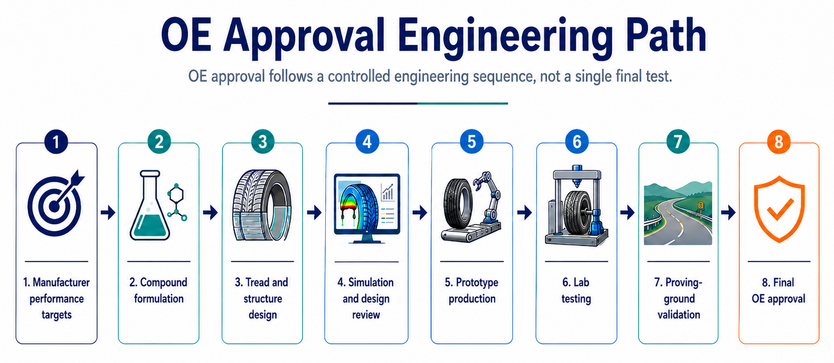
The process usually follows a controlled sequence:
1. Manufacturer performance targets
2. Compound formulation
3. Tread and structure design
4. Simulation and design review
5. Prototype production
6. Lab testing
7. Proving-ground validation
8. Final OE approval
This sequence matters because every late change affects cost, timing, and validation confidence. A compound change can alter wet braking or rolling resistance. A casing change can affect comfort, steering response, or high-speed stability. A tread change can improve water evacuation while changing noise behavior.
Lab and Proving-Ground Testing Separate Compliance From Approval
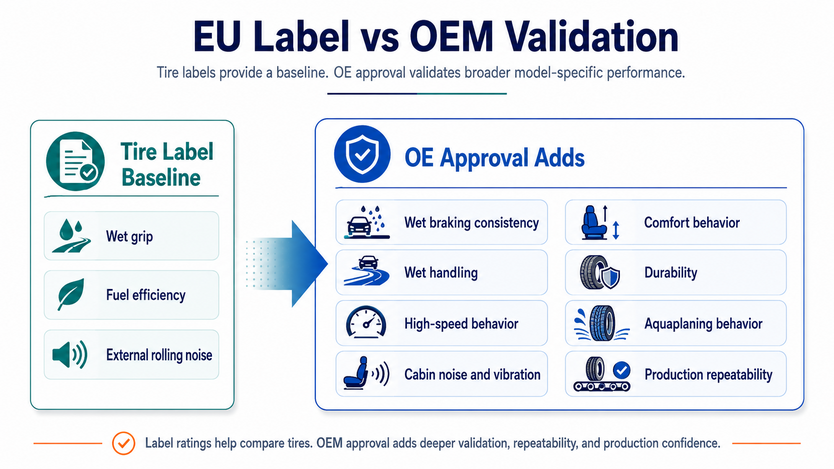
A tire label gives buyers a useful baseline. It doesn’t show how a tire behaves under repeated changes in load, speed, surface, and temperature for a specific production model. OE approval pushes testing further because manufacturers need proof across the full driving profile.
EU tire labels focus on fuel efficiency, wet grip, and external rolling noise. Those categories help buyers compare tires, but manufacturers evaluate a broader range of performance during approval. Road feel, braking stability, high-speed behavior, comfort, durability, and NVH all need deeper validation.
Lab and proving-ground testing turn design choices into measured evidence. Controlled braking tests show whether the tire performs consistently across surfaces. Wet handling checks how the tread design manages water under changing loads. High-speed testing, noise measurement, and durability loops show whether the tire maintains its behavior when stress increases.
Maxxis, for example, supports this validation work through its automotive proving ground, which includes 11 specialized test tracks and a 4.5 km high-speed track. The facility also supports braking, wet handling, noise, durability, and aquaplaning analysis. That testing depth connects compound, structure, and tread design to repeatable performance data.
European Validation Connects Global R&D With Regional Driving Demands
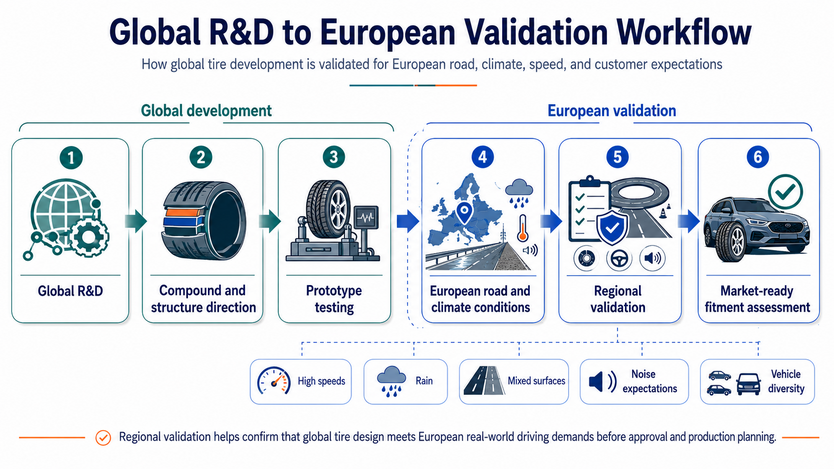
A tire design has to prove itself in the market where the car will run. European conditions add several pressure points: high motorway speeds, frequent rain, mixed road surfaces, strict noise expectations, and different vehicle categories using the same tire segment. These conditions expose details that controlled lab testing can’t fully show on its own.
Global development gives the tire its core structure, compound direction, and performance targets. European validation checks how those decisions behave under local road and climate conditions. That step helps confirm whether braking, steering response, comfort, noise control, and fuel efficiency through rolling resistance stay aligned with the model’s intended use.
For car manufacturers, this regional stage adds practical evidence to the technical file. A tire can meet internal targets in early testing and still need refinement once it faces different surfaces, speeds, temperatures, and driver expectations. European validation helps identify those gaps before the tire moves deeper into approval or production planning.
The same logic applies across modern performance segments. The Victra Sport 6 is the perfect example because it targets sport and premium vehicles across combustion, hybrid, and electric applications. Each application places different demands on grip, efficiency, load behavior, and noise control, so regional validation helps confirm that the tire’s design choices align with real operating conditions.
Premium OEM Approval Shows How Fitment Becomes Specific
Each brand follows its own internal procedures when developing tire requirements. For BMW, for example, the entire process focuses on moving from broad performance goals to exact fitment requirements. A tire doesn’t enter a production model because it performs well in general. It has to match a specific size, load rating, speed rating, handling profile, comfort target, and validation process.
In the BMW 1 Series, for instance, the approved Premitra HP5 fitment appears as 225/40R18 92Y XL. That specification defines more than size. It also defines the load and speed requirements that the tire must meet before the manufacturer can add it to the production program.
The Premitra 6 HP6A* shows the same narrowing process across several BMW fitments. Listed OE sizes include 215/45 R17 91Y XL, 205/55 R17 95Y XL, and 225/45 R18 95Y XL. Each size reflects a specific application, in which tire dimensions, load capacity, speed rating, comfort expectations, and handling behavior must align.
For manufacturers, examples like these show why OE approval depends on precision. The tire must support the car’s braking behavior, steering response, rolling resistance targets, comfort expectations, and validation requirements at the exact fitment level. That same logic applies across other manufacturer partnerships, even when the approval process, performance targets, or final specifications change.
OE Engineering Gives Retailers Better Value Arguments
Retailers don’t win long-term trust by explaining tires only through price. They need clear reasons why one tire fits a driver, car, season, and use case better than another. OE engineering gives that conversation a stronger foundation because it connects the product to tested performance, not only to visible features or label ratings.
That proof helps distributors move the discussion toward application fit. A tire developed around defined targets gives retailers more useful talking points around braking behavior, steering response, comfort, fuel efficiency , and lifecycle performance. It also makes technical recommendations easier to explain without turning the conversation into an engineering lecture.
The strongest retail value arguments usually come from a few clear points:
- OE approval gives retailers a stronger credibility signal.
- Application fit explains why one tire suits one car better than another.
- Seasonal suitability helps avoid wrong-use recommendations.
- Lifecycle performance supports clearer conversations around wear and tire age.
Manufacturer validation moves the discussion beyond price alone.
That retail conversation usually leads to more practical customer questions:
- What does an OE mark or manufacturer approval symbol mean?
- Is an approved tire different from the same size tire without that marking?
- Why does the same tire size behave differently on two cars?
- Should a replacement tire match the original approved fitment?
- How does manufacturer approval affect comfort, noise, braking, and handling?
- Does an approved marking mean the tire is also run-flat, or is that a separate feature?
How should customers compare an OE-approved option with a non-approved alternative?
OE-approved tires often carry a manufacturer marking on the sidewall. BMW-approved tires use the star marking. Mercedes-approved tires often use MO, which stands for Mercedes Original. These markings don’t mean every tire with the same size performs the same way. They show that the tire was developed or approved for a specific manufacturer application.
For distributors, this creates a more stable value story. The product no longer sits in the customer’s mind as a cheaper or more expensive alternative. It becomes a tire with a defined role, tested behavior, and a clear reason to exist within the retailer’s recommendation.
The Maxxis Way: Engineering Tires Around Real-World Application
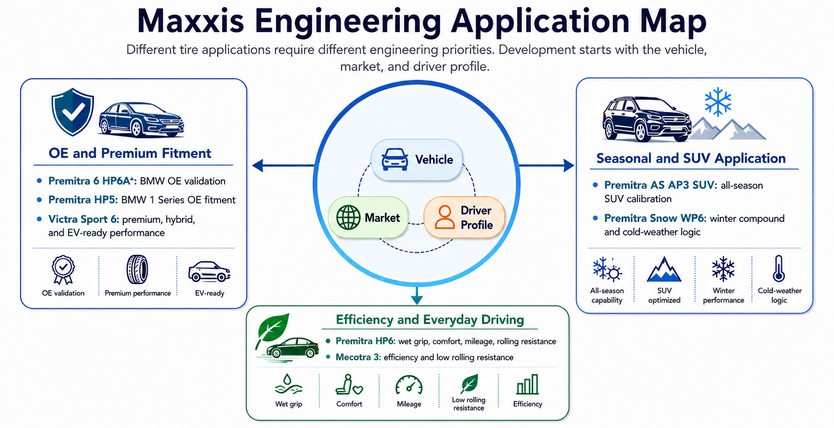
The BMW example shows how OE approval narrows a tire into an exact fitment. Maxxis applies the same logic across a wider range of vehicle types, driving conditions, and market needs. The starting point stays consistent: the tire has to match the application before it can deliver the right performance.
A touring car, a premium performance car, an SUV, a winter application, and an EV don’t ask the tire to solve the same problem. Each one places different demands on compound behavior, tread design, casing structure, road noise, fuel efficiency, and durability. That’s why the Maxxis car tires range doesn’t rely on one universal performance storyboard. It reflects different engineering priorities for different real-world use cases.
OE and premium fitment logic
Premitra 6 HP6A* and Premitra HP5 show how approval work connects to exact fitments, ratings, and performance expectations. Victra Sport 6 extends that logic to premium, combustion, hybrid, and electric applications, where grip, stability, water evacuation, and deformation control require a tighter balance. These examples show how tire engineering changes when the vehicle’s role changes.
Efficiency and everyday driving logic
Premitra HP6 and Mecotra 3 work from a different brief. Their value sits closer to daily driving, where wet grip, comfort, mileage, fuel efficiency, and low rolling resistance have to work together. This type of engineering doesn’t chase one headline result. It balances the areas that shape everyday performance across thousands of ordinary kilometers.
Seasonal and SUV application logic
Premitra AS AP3 SUV and Premitra Snow WP6 show how season, weight, and road conditions change the development brief again. An all-season SUV tire needs load support and predictable behavior in changing weather conditions. A winter tire needs a compound and tread that remain effective in cold, wet, snowy, or icy conditions. Those requirements create different design choices from the start.
Across these examples, the wider pattern becomes clear. Maxxis builds its tire logic around application fit, not around forcing every product into the same performance category. For OEM and B2B partners, that makes the discussion more practical. The conversation starts with the vehicle, the market, and the driver profile, then moves toward the tire design that can support those requirements.
Strategic OEM Partnerships Extend Beyond Tire Performance
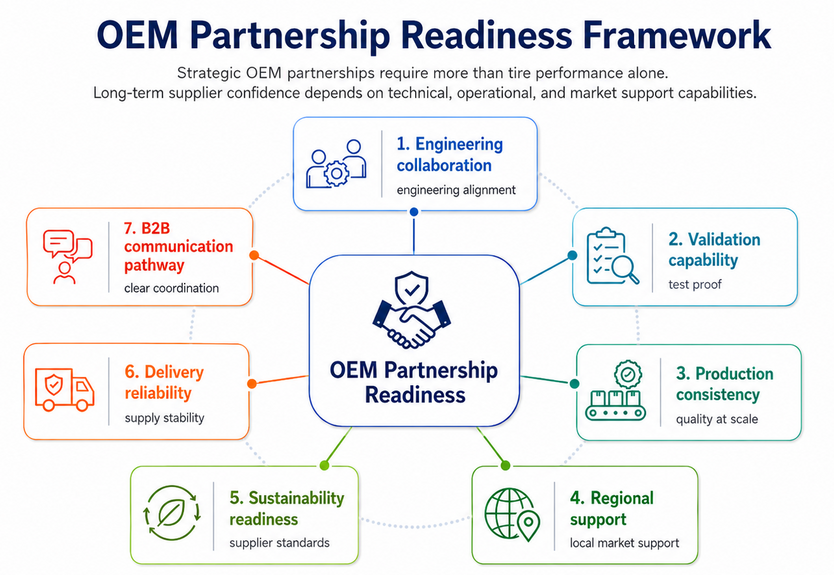
OE approval brings the tire into production planning, but partnership demands more than approved test data. A manufacturer also needs a supplier that can support development cycles, meet quality expectations, address regional requirements, uphold sustainability standards, and support delivery planning. Tire performance opens the door. Supplier discipline keeps the program stable.
Maxxis presents OE partnerships as more than supply agreements, which fits the broader reality of manufacturer collaboration. Tire development has to connect engineering work with production consistency, market support, and long-term communication. That combination gives OEM and B2B teams more confidence when a tire moves from validation into real supply.
The strongest partnerships usually depend on several connected capabilities:
- Engineering collaboration aligns the tire with the car’s requirements.
- Validation capability proves performance under controlled and regional conditions.
- Production consistency protects quality at scale.
- Regional support adapts global development to local markets.
- Sustainability readiness supports supplier expectations.
- Delivery reliability reduces launch and supply risk.
Once approval moves toward production, the focus shifts from proving the tire once to maintaining the same result repeatedly. Manufacturers need consistent quality, stable supply, clear communication, and regional support throughout the program. That operational layer protects the work done during development and keeps the approved tire aligned with the production model after validation ends.
The engineering path to OE approval starts with compound design, but it doesn’t end with a test result. It reaches production planning, retailer confidence, and the driver’s experience after the car reaches the road. For manufacturers and B2B partners, that makes tire development a long-term technical conversation, shaped by performance targets, market needs, and the standards behind every approved fitment.